Thousand words said, but no meaning, no sense! That is the reality of the modern workplace, and surely you have noticed it at your office. We exist in a strange era where plain speaking has been replaced by corporate jargon, a complicated code of professional riddles. It is a peculiar form of evolution: long ago, our ancestors used clear signals to avoid predators, yet we use “strategic synergy” just to avoid giving a straight answer.
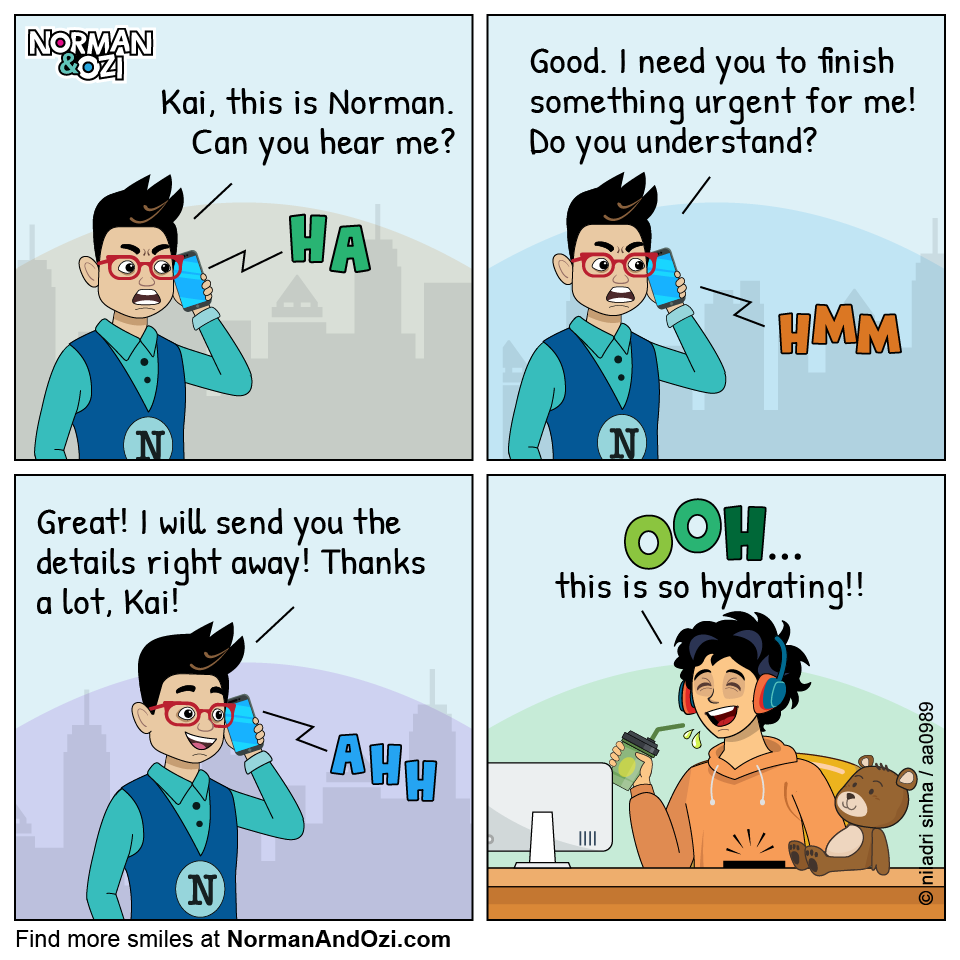
We open a chat window, read a message that looks like a greeting, and realize we need a specialized glossary just to understand our own lunch break. So here is one: an honest office dictionary of what people say vs. what they mean at work, brought to you by Norman & Ozi.
The Prestige of the Buzzword: Why We Love Corporate Jargon
Humans possess a unique talent for complicating the simple. We feel a sense of accomplishment when we use corporate buzzwords like “pivoting” or “holistic approach,” as if adding extra syllables to a mistake suddenly makes it a strategy. We take it as a sign of status when someone asks us to “socialize a deck,” as if the PowerPoint is going to put on a suit and go out for dinner with the team.

We find comfort in this jargon avalanche. We feel vital when we use phrases that would give imposter syndrome to our colleagues. However, the moment the conference call drops, the reality hits: we have spent forty minutes discussing “low-hanging fruit” without ever touching a single metaphorical tree. (Yes, I think I am under the influence of the topic: The Office Dictionary: What People Say vs. What They Mean.)
The Office Dictionary: Corporate Jargon Decoded
In the modern cubicle, speaking clearly is often seen as a lack of sophistication. You have to bisect, dissect, and intersect every sentence like a detective looking for a motive. Here is the unofficial dictionary of the workplace. Each entry gives the polite meaning first, then the Norman & Ozi translation.
Corporate jargon at a glance
| What they say | What it means | What they really mean |
|---|---|---|
| I’ll let you have some time back | The meeting ends early | I’m bored and want to scroll |
| Let’s take this offline | Discuss privately later | Stop embarrassing us in public |
| As per my last email | I already answered this | Why am I the only one who can read? |
| Let’s circle back | Postpone the topic | This topic is now in orbit |
| I don’t have the bandwidth | I’m too busy | I’m not interested |
| Low-hanging fruit | Easy wins | Things we’ll discuss, never pick |
| Quick question | I need to ask something | Cancel your next hour |
| Let’s touch base | Short check-in | A meeting about nothing |
Ozidom: Office Wisdom from Ozi
Norman’s pet owl, Ozi, keeps a dictionary of his own. He calls it Ozidom: short, sarcastic truths about office life. A few favourites:

Want more of Ozi’s wisdom? Read all Ozidom office quotes
This is the Linguistic Paradox: the more tools we have for communication, the less we actually manage to say to one another.
The Tragedy of the Script
The vocabulary is exhausting. The “alignment sessions” are draining. The “Work-Life Balance” we define in our dictionaries feels like a work of fiction. The tragedy is that we have allowed the terminology to dominate our reality. We are surrounded by words that were supposed to clarify our goals, but they have only made us work harder to decode the noise.
[COMIC 4 — closing strip] A work-life balance or “at capacity” strip. Alt text: Norman & Ozi comic about work-life balance and office burnout Caption: Currently at capacity. Please try again never.
Before the day comes when your toaster tells you it is “currently at capacity and lacks the bandwidth to toast your bread”: read my comics. Appreciate my foresight and hindsight, and laugh aloud while you still remember how to speak like a human being.
I will be back next week with a new entry in The Office Dictionary to tickle your funny bone. Until then, meet the Norman & Ozi characters.
FAQs
Corporate jargon is the specialized, often vague language used in offices, such as “synergy,” “circle back,” or “bandwidth.” It is meant to sound professional and efficient, but it often hides the real message, making simple ideas harder to understand.
People use corporate buzzwords to sound competent, to fit into office culture, and to soften difficult messages like “no” or “you’re wrong.” Buzzwords can also signal status or avoid commitment, which is why a meeting full of them can end without a single clear decision.
“As per my last email” is not openly rude, but it is widely read as passive-aggressive. It politely signals “I already told you this” and suggests the reader did not pay attention. For a friendlier tone, try “Just to recap what I shared earlier.”
Some of the most common corporate buzzwords are “let’s take this offline,” “circle back,” “touch base,” “bandwidth,” “low-hanging fruit,” “synergy,” “pivot,” “holistic approach,” and “as per my last email.”
Say the direct version of what you mean: “I’m too busy” instead of “no bandwidth,” “let’s talk later” instead of “circle back.” Use short sentences, name the action and owner, and ask yourself whether a new colleague would understand the message on first read.
Norman & Ozi is a corporate humor comic series about office life, meetings, and workplace culture. The comics are published on normanandozi.com and in print magazines, and new strips and Office Dictionary entries are released regularly.
About the author: [Cartoonist name] is the creator of Norman & Ozi, a corporate humor comic published online and in print magazines. [One line on background, e.g. years in corporate life.] [Link to author/about page]